Best Compact Binoculars for Hiking and Travel
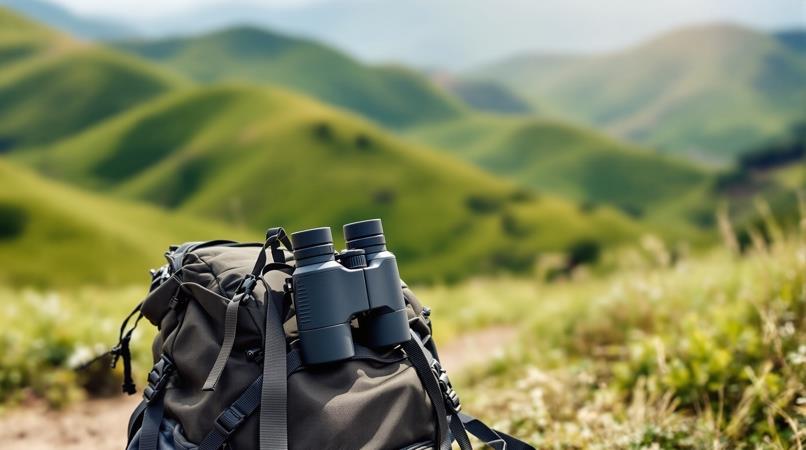
A good pair of binoculars can make a bird, a trail marker or a mountain detail something taking time for but big binoculars are often left in the car or, at home. Small models fix this problem by not taking space and adding a weight to a day pack. The downside is that smaller designs can offer views, performance in low light and more difficulty in holding them steady. For hiking and traveling the best choice is not the model; it is the one that you will carry, hold and use in a comfortable way.
Start with the size you will actually carry
Compact binoculars usually have lenses than full-size outdoor models. This makes them easier to carry. It also means less light reaches your eyes. For a day in weather a compact design can work well. In woods at dusk or when watching wildlife on days the difference between small and slightly bigger models becomes more obvious.
The most easy to carry options often have an 8×25 or 10×25 setup. The first number is magnification the second is the diameter of each lens in millimeters. An 8×25 pair makes a subject eight times bigger. Uses 25 mm lenses. A 10×25 pair gives detail at a distance. It also makes hand movement more noticeable and usually has a narrower view.
A bigger 8×32 model is often the choice for hiking. It is still easy to carry in a day pack while letting in light and offering a relaxed view. It may not fit in a jacket pocket well. This is a trade-off between portability and easier viewing, not a simple quality comparison.
Choose magnification for stability and distance
Eight-power binoculars are a starting point for travel and trails. They are easier to hold steady show an area and help in finding a moving bird or animal. That wider view also helps when looking at scenery or following a path feature without moving the binoculars.
Ten-power binoculars can help when distant things are important like wildlife in an area or details on a hill. The extra magnification does not always show detail. If the picture shakes the benefit quickly disappears. Small 10x models can be harder to use because their short light bodies offer help against hands.
Think about how you use binoculars. If you mostly look at woods, city sights, campsites and wide landscapes 8x is usually easier. If you often watch things in light and can hold binoculars steady 10x may be better. Do not pick magnification just because the number sounds better on the box.
Read the specifications without getting confused
The exit pupil is the beam of light coming out of each eyepiece. You can estimate it by dividing the lens size by the magnification. An 8×25 pair has an exit pupil of 3.1 mm while an 8×32 pair has 4 mm. A bigger exit pupil can make the view more forgiving if your eyes are not perfectly lined up with the lenses and can help in light. It cannot turn a small pair into a night vision tool.
Field of view tells you how much of the landscape you can see at a distance. A wider view is useful for finding birds watching moving things and enjoying a trail scene. Manufacturers may show it as an angle or as a width at a distance so compare numbers when they use the same way of measuring. A wide view is helpful, but sharpness and distortion at the edges affect how nice it feels.
Eye relief matters if you wear glasses. It is the distance from the eyepiece where you can see the view. Look for eyecups. Check the manufacturers eye-relief number but remember that these numbers are not always given the same way. With glasses on. Twist the eyecups down as designed and make sure you can still see the image, not just a circle.
Check the design. Build
Most modern binoculars use roof prisms because the straight shape is small and easy to carry. Porro-prism binoculars can offer depth and clear images. Their larger shape is not as easy to put in a pocket. Either design can work for travel; the main thing is how the whole binocular works and fits your use.
Coatings are more important than claims about being " coated." Anti-reflective coatings reduce loss at glass surfaces. Can make the image clearer. Fully multi-coated models are usually better than ones with some coatings. Coating words do not tell everything about sharpness or color quality. A simple, made binocular can be more enjoyable than a made one with fancy words on the box.
Look for a smooth center focus wheel a diopter adjustment and a hinge that does not feel loose. The diopter helps adjust for differences between your eyes; it is not a fix for focus. Rubber covering can help with grip. Protect from bumps but it does not mean the binocular is waterproof. Weatherproofing should be clearly stated, not assumed from an outside.
Match the binoculars to the trip
For air travel, museums, city walks and sightseeing the smallest 8×25 models have a benefit. They fit in a bag. Are less likely to bother you during long periods of carrying. Their limited light gathering is less important when you mainly look in daylight.
For day hikes 8×32 binoculars are often worth thinking about if your pack can fit them. They can be more comfortable for repeated use especially when you stop to look at slopes or forest edges. If every gram matters because you are carrying gear a compact 8×25 model may still be the choice because it will be more likely to come along.
For wildlife watching focus on a view a field of view and comfortable eye placement over the highest magnification. For sports a wide view and fast focusing may be more important than reach. For travel folding or small size may be more important than differences in image quality.
Common errors before you buy
The first error is seeing weight as the sign of portability. A binocular that is a little lighter but uncomfortable to hold may be used often than a bigger model that feels better. Check the folded size as the weight especially if it needs to fit a certain pocket or case.
Another error is thinking a bigger lens always means an better image. Brightness depends on lens size, magnification, coatings, glass quality, eye alignment and lighting. A bigger lens can also make the binoculars larger and heavier. Compare the setup of chasing just one number.
Do not miss the focus number if you like flowers, insects, exhibits or nearby details. Also do not ignore the focus wheel: stiff, loose or awkward controls can become annoying on every trip. If possible look through the binoculars before buying or buy from a seller with a return policy so you can check for comfort with your glasses and hands.
Finally do not expect small lenses to work like binoculars at dusk. Compact models are made for convenience. Their strength is being there when a larger pair would be left behind.
For hikers and travelers start with 8x magnification compare 8×25 and 8×32 models by size when packed and pay attention to field of view eye relief and focus feel. Choose 10x when distant viewing is clearly important and you can hold it steady. The best binoculars, under $100 are the ones that honestly balance those choices and end up in your bag of on a shelf.